 2026-10-07
Six Tales for the Candlelit Hour: A Listener's Guide to Poe
On October 7, 1849, Edgar Allan Poe died in Baltimore. He was forty years old, and nobody has ever fully explained how he died. It's a fittingly unresolved ending for the writer who taught us that the most frightening thing in a story is often what's left unsaid.
So tonight we're lighting a candle for him the best way we know how: by listening.
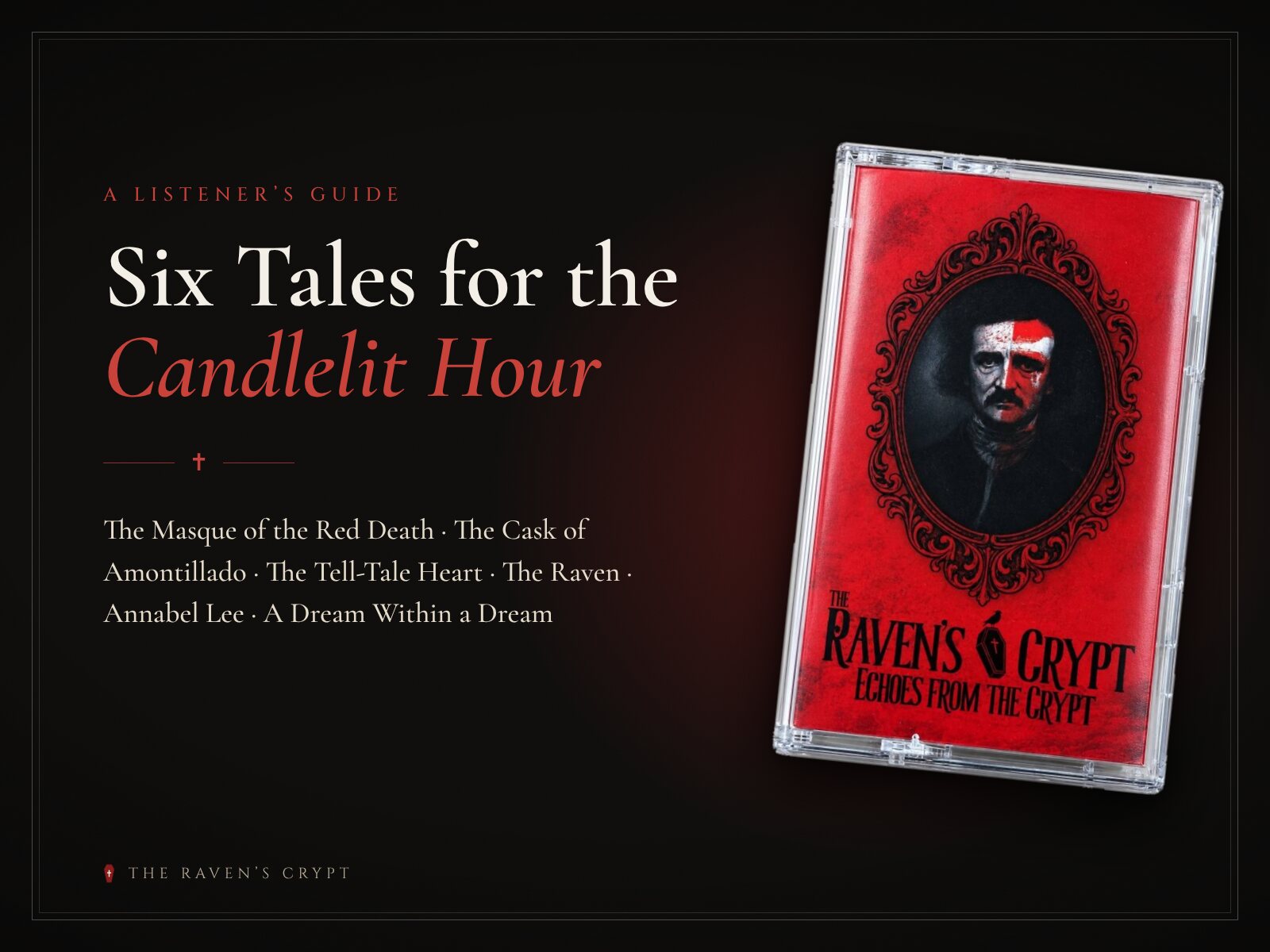
Echoes from the Crypt gathers six of Poe's essential works in spoken word, three tales and three poems. Here's a short guide for the first listen: what each piece is about, and the moment to listen for.
Side One
The Masque of the Red Death (1842)
A plague called the Red Death is sweeping the land. Prince Prospero seals himself and a thousand courtiers inside a fortified abbey and throws a masquerade while the world outside dies. The party moves through seven rooms, each a different colour, and the last is black, lit through blood-red glass. In it stands an ebony clock whose chimes stop the dancers cold every hour.
Listen for: the clock. Every time it strikes, the music stops, and so does the story. Then a stranger arrives in costume, dressed as the very thing they were hiding from.
The Cask of Amontillado (1846)
"The thousand injuries of Fortunato I had borne as I best could, but when he ventured upon insult, I vowed revenge." Montresor lures his rival, drunk and dressed in a jester's motley for carnival, down into the family catacombs with the promise of a rare wine. You already know where this is going. Fortunato doesn't.
Listen for: the bells on Fortunato's cap. They jingle all the way down into the dark, and they're the last thing you hear.
Side Two
The Tell-Tale Heart (1843)
"True! — nervous — very, very dreadfully nervous I had been and am; but why will you say that I am mad?" Poe's most unreliable narrator insists he is perfectly sane, and explains, with great care, how he killed an old man because of his pale, filmed "vulture eye".
Listen for: the pacing. The narrator speeds up as his calm gives way. By the time the police are sitting over the floorboards, you'll hear the heartbeat too.
The Raven (1845)
The poem that made Poe famous almost overnight when it appeared in January 1845, and the poem this whole Crypt is named for. A grieving scholar, a bleak December midnight, a lost love named Lenore, and a bird that knows exactly one word.
Listen for: how "Nevermore" changes. It starts out sounding like a novelty, a bird that can talk. Each time it comes back it hits harder, until it's the answer to every question the narrator is afraid to ask.
Annabel Lee (1849)
One of Poe’s final poems, published in the days after his death. It's a love story in a "kingdom by the sea", about a love so complete that "the angels, not half so happy in Heaven" grew jealous of it. It is the gentlest thing on the tape, and maybe the saddest.
Listen for: the repetition. Poe returns again and again to the same few phrases, "the kingdom by the sea", "my beautiful Annabel Lee", the way the mind circles a loss it can't put down.
A Dream Within a Dream (1849)
The tape closes with one of Poe’s most haunting questions. A man stands on a shore, holding grains of golden sand that slip through his fingers no matter how tightly he grips them.
Listen for: the final line. "Is all that we see or seem / But a dream within a dream?" Then the tape runs out.
How to listen
Wait until it's properly dark. Turn the lights down, light a candle if you have one, and play both sides straight through, in order. These pieces were written to be read aloud: Poe himself gave public readings of "The Raven", and he believed a poem should be short enough to experience in a single sitting. On tape, with the hiss and the click of the deck between sides, they sound the way they were meant to.
Echoes from the Crypt is on limited blood-red cassette in a clear shell. Find the current availability in the shop.
Hear the six tales → Echoes from the Crypt, $15
If "The Raven" is the one that gets you, it's also pressed on a hand-numbered blood-red 7″, and as an illustrated zine for the shelf.
Rest well, Mr. Poe.
— The Raven's Crypt