 2026-10-08
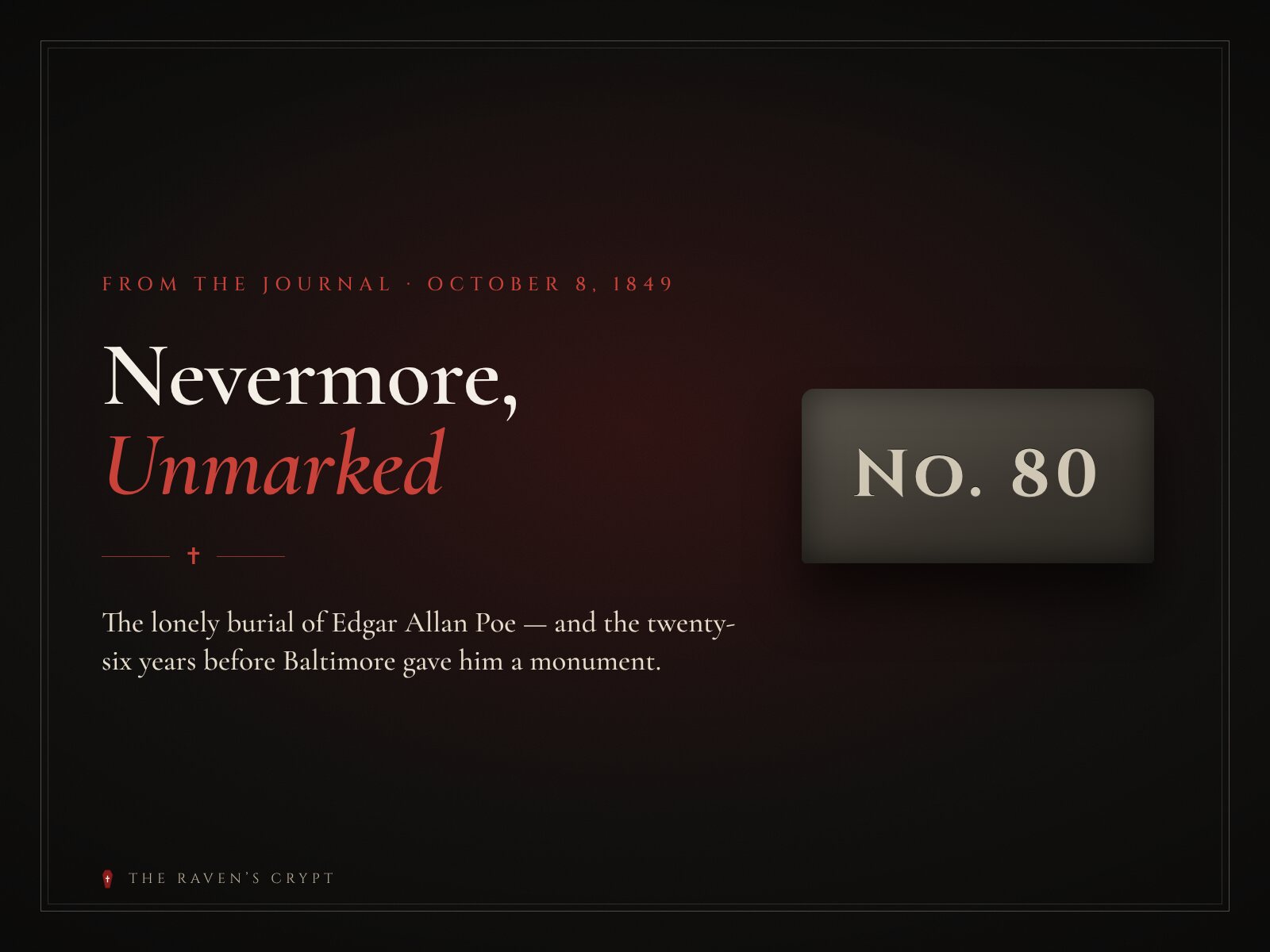
Nevermore, Unmarked: The Lonely Burial of Edgar Allan Poe
On the afternoon of Monday, October 8, 1849, Edgar Allan Poe was buried in Baltimore. He had died the day before, at forty, and the man who wrote "The Raven" went into the ground with almost no one there to see it.
How he got there
Poe's last days are still a mystery. On October 3, an election day, he was found delirious at Ryan's tavern near a Baltimore polling place, wearing shabby clothes, described in later accounts as unfamiliar. A printer named Joseph W. Walker sent a hurried note to Poe's acquaintance Dr. Joseph E. Snodgrass: there was a gentleman "rather the worse for wear" who "appears in great distress."
Poe was taken to Washington College Hospital. Accounts of his final days are conflicting; he died on Sunday, October 7. His medical records, if they ever existed, have been lost. Nobody has ever settled what killed him.
The funeral
The service was held at 4 p.m. the next day at the Presbyterian burying ground on Fayette and Greene Streets, now known as Westminster Burying Ground. It was arranged quickly and cheaply:
- His uncle-in-law, Henry Herring, supplied a plain mahogany coffin with no handles, no nameplate, no cloth lining, and not even a cushion for his head.
- His cousin Neilson Poe provided the hearse.
- The wife of his doctor, John J. Moran, sewed his shroud.
Only a handful of people came: Neilson Poe; Dr. Snodgrass; Z. Collins Lee, a classmate from the University of Virginia; his cousin Elizabeth Herring and her husband; and Joseph Clarke, his old schoolmaster. The Reverend W. T. D. Clemm, a cousin of Poe's late wife Virginia, had prepared a sermon. Seeing how few were there, he skipped it. The whole service lasted about three minutes.
George W. Spence, the sexton who oversaw the burial, remembered the weather years later:
"It was a dark and gloomy day, not raining but just kind of raw and threatening."
Poe was laid in his family's lot, near his grandfather, "General" David Poe, Sr. The grave was unmarked.
The headstone that never arrived
Neilson Poe ordered a headstone of white Italian marble. It was finished, but before it could be delivered, a train derailed and ploughed into the stonecutter's yard, destroying it.
No replacement came. For years the only thing that marked the grave of one of the most famous writers in America was a sandstone block carved with a number: No. 80.
Twenty-six years later
By 1865, Baltimore schoolteacher Sara Sigourney Rice was leading a campaign for a memorial. Schoolchildren and other supporters contributed; a gift from George W. Childs helped complete the fund in 1874.
Poe's remains were moved to a new grave near the front of the churchyard, and on November 17, 1875 the monument was dedicated with a public ceremony. Neilson Poe spoke, calling his cousin "one of the best hearted men that ever lived." Leading poets of the day were invited. Only one came: Walt Whitman. Letters from Tennyson and other poets were read at the ceremony.
Ten years later, on January 19, 1885 — what would have been Poe's 76th birthday — the remains of his wife Virginia were laid beside him. Her mother, Maria Clemm, already rested there. In 1913 a separate stone was placed to mark his original burial spot, carved with a raven and the words "Quoth the Raven, Nevermore."
Why it stays with us
There's something almost unbearably Poe about it all: the unexplained death, the unfamiliar clothes, the three-minute service under a raw grey sky, the headstone smashed by a runaway train, the number where a name should be. If he had written it, an editor would have called it too much.
But the ending is kinder than the beginning. The grave almost no one visited in 1849 became a place of pilgrimage. Visitors still leave pennies and flowers, and the mysterious "Poe Toaster" tradition brought roses and cognac to his grave on his birthday, documented from 1949 through 2009.
Tonight, on the anniversary of the day they buried him, we're lighting a candle and putting on "The Raven."
Hear Poe read aloud → Echoes from the Crypt, $15
If you missed it, yesterday we published Six Tales for the Candlelit Hour, a listener's guide to six of his most haunting works.
Rest well, Mr. Poe.
— The Raven's Crypt
Sources
- Kenneth Silverman, Edgar A. Poe: Mournful and Never-Ending Remembrance (1991)
- Mary E. Phillips, Edgar Allan Poe: The Man (1926)
- The Edgar Allan Poe Society of Baltimore: Poe’s Original Burial Place and Poe’s Memorial Grave
- Dwight R. Thomas and David K. Jackson, The Poe Log (1987), October 1849 entries